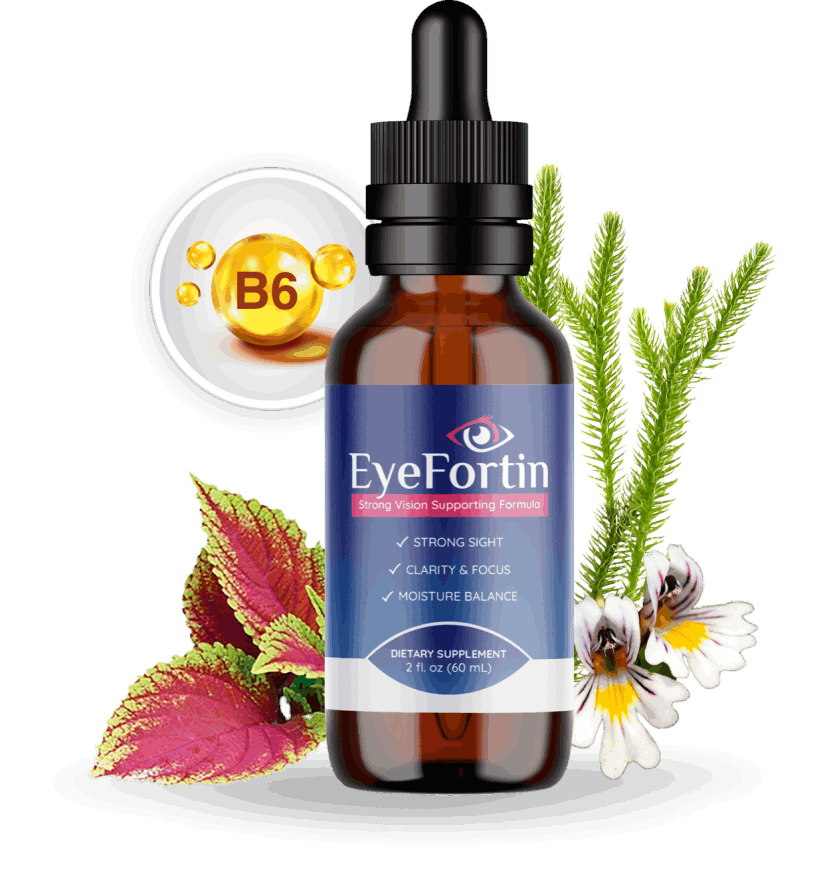
EyeFortin — Does It Still Work? 2026
EyeFortin is a liquid vision support formula — built around the science of glutamate receptor function rather than the tired antioxidant blends that dominate this category — designed for adults who spend hours under artificial light and have noticed their visual clarity, sharpness, or low-light performance starting to slip.
Your Eyes Are Working Harder Than Ever — And Getting Less Back
From a mechanism perspective, screens, LEDs, fluorescent lighting — modern life has quietly rewritten the conditions your visual system evolved to handle.
Viewed independently, hours of close-focus work under artificial light leave eyes fatigued, focus sluggish, and night vision noticeably worse than it used to be. That gradual slide feels inevitable, but evidence is emerging that it may not be.
- ✕Driving at night has become genuinely stressful — headlights feel blinding and road edges blur in a way they simply didn't before.
- ✕Reading fine print requires more light, more squinting, and more concentration than it should for someone your age.
- ✕Eye strain by mid-afternoon has become so predictable that you plan your day around it rather than doing anything to address it.
Eye drops and screen filters address the symptom at the surface level, but they do nothing for the underlying signalling pathway between your eyes and brain — and that's where the real breakdown tends to happen. Until that pathway gets support, the fatigue keeps coming back.
EyeFortin: A Glutamate-Receptor Approach to Vision Support
In the context of this formula, adults who spend the majority of their day under artificial lighting — and particularly those noticing progressive changes in visual sharpness, contrast sensitivity, or night vision — are the clearest fit for what EyeFortin is designed to do. Unlike standard lutein-and-zeaxanthin capsules aimed at macular pigment density alone, this formula takes a neurological angle on eye health support.
Viewed independently, eyeFortin's ingredient rationale centres on glutamate receptors — the signalling structures that translate incoming light data from the retina into visual information processed by the brain. Compounds like L-Glutamic Acid, Alpha GPC, and Huperzine A were chosen because each one has been studied in the context of neurotransmitter function, acetylcholine signalling, or neuroprotection — mechanisms directly relevant to visual processing rather than just retinal pigment support. Taurine adds an antioxidant dimension specific to photoreceptor cells, and Eyebright Extract brings traditional botanical support that has been used in ocular wellness contexts for centuries.
Where most eye health drops focus on surface lubrication, EyeFortin's liquid dropper format is designed to deliver its neurologically-targeted compounds systemically — addressing the brain-eye signalling chain that topical products cannot reach.
How EyeFortin Targets the Brain-Eye Signalling Pathway
Glutamate Receptor Support
From an ingredient standpoint, l-Glutamic Acid and Alpha GPC work within the glutamatergic signalling system — the primary excitatory pathway through which retinal photoreceptors communicate with the visual cortex. Prolonged artificial light exposure is hypothesised to dysregulate these receptors over time, reducing signal fidelity. Supplying precursors and cholinergic cofactors may help maintain receptor responsiveness.
Acetylcholine Pathway Activation
Viewed independently, huperzine A inhibits acetylcholinesterase, the enzyme that breaks down acetylcholine in synaptic gaps. By preserving available acetylcholine, this mechanism may support sharper neural signal transmission — not just in general cognition but specifically in the rapid-fire processing demanded by visual tasks. Alpha GPC provides the choline substrate that feeds this same pathway upstream.
Photoreceptor Antioxidant Protection
From a mechanism perspective, taurine is one of the most concentrated amino acids found naturally in retinal tissue. Research has examined its role in protecting photoreceptors against oxidative stress, which accumulates under conditions of high light exposure. Eyebright Extract complements this with flavonoid compounds historically associated with ocular anti-inflammatory support.
What People Are Reporting With EyeFortin
Representative experiences — results are not guaranteed
“Came across this in a newsletter about screen fatigue — by week three, night driving felt noticeably less stressful.”

“A friend pushed me to try it and I was openly sceptical — I spend ten hours a day on screens and assumed my eyes were just done. By week eleven, reading documents on my second monitor without squinting had quietly become normal again. Three sentences doesn't do it justice — the change was gradual but real.”

“Lutein capsules did nothing. Blue-light glasses helped marginally but the fatigue came back by noon regardless. Twelve weeks on EyeFortin and my morning reading routine no longer ends with a headache — that alone made it worth it.”

What Sets This Formula Apart
 Good Manufacturing PracticeThird-party manufacturing quality audit
 Registered FacilityFDA facility registration on file
 Made in USADomestic US manufacturing
 100% NaturalClean ingredient profile — no artificial compounds
Select Your EyeFortin Package
Select your preferred supply option below


Available Through: Available through one channel only — the manufacturer's website. Marketplace listings carry no guarantee.
What EyeFortin May Support
Sharper Visual Signal Processing
Practically speaking, alpha GPC and Huperzine A together target the acetylcholine pathway that governs how quickly and cleanly the brain processes incoming visual data. Users report that detail recognition — particularly in low-contrast environments — feels more effortless over time.
Reduced Eye Fatigue After Screen Use
Put simply: taurine's concentration in retinal tissue makes it a logical candidate for supporting photoreceptor recovery after sustained artificial light exposure. Most users report that the mid-afternoon eye strain they'd normalised begins to ease within the first several weeks of consistent use.
Improved Low-Light Visual Adaptation
Viewed independently, l-Tyrosine's role as a retinal dopamine precursor may support the eye's dynamic range — particularly its ability to adapt when moving between bright and dim environments. Night vision difficulty is one of the most commonly reported improvements among longer-term users of this formula.
Neurotransmitter Support for the Visual Cortex
At the whole-formula level, l-Glutamic Acid provides direct substrate support for the glutamatergic signalling that runs from photoreceptors through to visual cortex processing. Supporting this pathway may help maintain the brain's ability to construct clear, detail-rich images from retinal input.
Retinal Cell Energy Supply via NAD+ Pathways
On a closer look, niacin's conversion to NAD+ supports mitochondrial function in retinal cells, which have some of the highest metabolic energy demands in the body. Sustained cellular energy availability may underpin several of the other visual support benefits this formula targets.
Ocular Anti-Inflammatory Support
At a practical level, eyebright Extract's flavonoid content has been associated with anti-inflammatory activity at the ocular surface level. Users experiencing redness or irritation alongside visual fatigue may notice secondary comfort improvements alongside the core clarity benefits.
Liquid Dropper Format for Systemic Delivery
In the context of this formula, sublingual and liquid dropper delivery bypasses some of the absorption inefficiencies associated with standard capsule formats. For neurologically-targeted compounds like Huperzine A, bioavailability consistency may matter more than it does for basic vitamin supplementation.
Stimulant-Free Daily Use Profile
From a mechanism perspective, zero stimulant compounds in the EyeFortin formula means no jitter, no afternoon energy crash, and no interference with sleep quality — a meaningful practical advantage for a supplement intended for long-term daily use.
EyeFortin Ingredients
9 targeting glutamate receptors, retinal neurotransmission, and ocular oxidative stress
In the context of this formula, retinal tissue naturally concentrates taurine at levels higher than almost any other amino acid in the body — a distribution pattern that points clearly to its functional importance in photoreceptor health. Research has examined taurine's role in protecting rod and cone cells from oxidative damage, particularly under conditions of sustained or high-intensity light exposure. Animal models have shown retinal degeneration under taurine deficiency, and human studies have looked at its antioxidant contribution to ocular tissue maintenance. The mechanism is well-studied at the cellular level; individual outcome variation based on baseline taurine status is the key uncertainty when translating those findings to supplementation.
Put simply: cholinergic signalling deficits affect visual processing speed and neural transmission clarity — and Alpha GPC addresses this by delivering a highly bioavailable form of choline that crosses the blood-brain barrier efficiently. Unlike standard choline bitartrate, Alpha GPC is preferentially taken up by neural tissue, where it serves as a direct precursor to acetylcholine synthesis. Research on Alpha GPC has focused substantially on cognitive performance and neural signal integrity, with the mechanism of action directly applicable to the rapid processing demands of visual cortex function. Synergy with Huperzine A — which slows acetylcholine breakdown — makes this pairing particularly coherent from a neurochemical standpoint.
On a closer look, across multiple trials examining acetylcholinesterase inhibition in neural tissue, Huperzine A has demonstrated consistent activity as a reversible inhibitor of the enzyme responsible for acetylcholine degradation. Extracted from Huperzia serrata moss, it has been studied in contexts ranging from memory support to neuroprotection, with a well-characterised mechanism that distinguishes it from most botanical nootropic ingredients. Its application to visual processing support is an extrapolation from the established neurotransmission research — logical given the brain's role in constructing vision, though direct ocular outcome trials are limited. Dosing precision matters considerably with this compound, as its activity window is narrow.
At a practical level, among compounds studied for retinal neurotransmitter function, L-Glutamic Acid stands out because it is the primary excitatory neurotransmitter used by retinal photoreceptors and ganglion cells to relay visual signals toward the optic nerve. Glutamate receptors in the retina and visual cortex process contrast, motion, and fine detail — making this amino acid fundamentally relevant to the specific mechanism EyeFortin's sales rationale centres on. Research into glutamatergic signalling in ocular health is substantial, though supplemental L-Glutamic Acid's ability to modulate receptor-level function involves complex feedback dynamics. The research is robust for glutamate's role in visual neurotransmission; whether oral supplementation meaningfully shifts receptor sensitivity remains an area of active investigation.
From a mechanism perspective, compared to other botanicals in the eye health category, Eyebright (Euphrasia officinalis) has a distinctive research profile built largely on traditional European herbal medicine use, with modern phytochemical analysis identifying flavonoids and iridoid glycosides as its likely active contributors. Studies have examined its anti-inflammatory and astringent properties in the context of ocular surface irritation and conjunctival health. The traditional indication aligns well with the product's target audience — those experiencing irritation and visual fatigue from prolonged screen exposure. Rigorous randomised controlled trial data specific to oral Eyebright supplementation is limited, which is worth noting alongside its long history of use.
In clinical terms, in research involving cognitive stress and neurotransmitter depletion, L-Tyrosine has been examined for its role as a precursor to dopamine, norepinephrine, and melanin — with dopaminergic signalling in the retina representing a specific pathway of relevance here. Retinal dopamine plays a documented role in visual acuity regulation and the eye's adaptive response to light conditions. The research on L-Tyrosine's cognitive and neurological support functions is robust; its application specifically to retinal dopamine dynamics in a supplementation context involves some degree of extrapolation from broader neurotransmitter research.
Viewed independently, within cellular energy metabolism pathways, Niacin (Vitamin B3) has been extensively studied as a precursor to NAD+ — a coenzyme essential for mitochondrial function across all metabolically active tissues, including retinal cells which have exceptionally high energy demands. Research has also examined Niacin's role in maintaining the integrity of retinal ganglion cells, with deficiency historically associated with visual disturbances. Scientific literature links this compound to NAD+ synthesis and retinal ganglion cell neuroprotection. NIH Reference →
Who Should Not Use EyeFortin
Objectively, certain groups should exercise caution or consult a qualified healthcare provider before adding EyeFortin to their routine, given the neurologically-active compounds in its formulation.
Anyone managing an existing health condition or taking prescription medication should seek guidance from a licensed healthcare professional before beginning any new supplement regimen.
My EyeFortin Ratings
Practically speaking, scores reflect editorial assessment based on ingredient research, guarantee terms, and category comparison — not lab testing or brand affiliation.
From an ingredient standpoint, the EyeFortin ingredient stack is notably more sophisticated than the standard lutein-zeaxanthin-bilberry trio that accounts for the majority of eye health supplements on the market. Huperzine A, Alpha GPC, and L-Glutamic Acid targeting a neurological mechanism is genuinely above category average. What is absent — and worth noting — is any patented, third-party validated ingredient form such as FloraGLO lutein or OptiMSM, which would push the score higher.
At a practical level, at the six-bottle tier, EyeFortin comes in at $49 per bottle — competitive for a liquid-format neurological support formula with nine active compounds, particularly given the 60-day guarantee backstop. Standard lutein capsules often undercut this price, but they are not targeting the same mechanism. The single-bottle entry point at $69 is above average for a first-trial cost, which is the main value friction point for cautious new buyers.
Objectively, eyeFortin is produced in a GMP-certified facility, which provides meaningful assurance of batch consistency — particularly important for dose-sensitive compounds like Huperzine A where variance between batches can affect both efficacy and tolerability. No third-party certificate of analysis is publicly accessible on the product page, which limits the manufacturing score relative to brands that publish independent lab verification. Domestic US production reduces contamination risk relative to offshore manufacturing.
Breaking Down EyeFortin
- Huperzine A included — a neurologically-active compound rare in eye supplements
- Alpha GPC's acetylcholine research is among the most robust in this formula's ingredient stack
- Nine-compound formula addresses glutamatergic, cholinergic, and antioxidant pathways simultaneously
- Manufactured in a GMP-certified facility ensuring batch-level dosing consistency
- Stimulant-free — suitable for sustained daily use without tolerance concerns
- Full cash refund within 60 days — no return shipping required
- Single-bottle entry price is higher than category average
- Liquid dropper format requires slightly more daily routine mindfulness than capsules
Our Rating: 4.6/5 — Worth the money — conditionally. EyeFortin stands apart from the generic antioxidant blends that dominate this category by targeting the glutamatergic and cholinergic pathways that govern how the brain actually processes visual input. Huperzine A and Alpha GPC are not ingredients you typically find in eye health formulas, and their inclusion signals a formulation philosophy grounded in neurological science rather than marketing convenience. Taurine and Niacin add retinal-level cellular support that rounds out the mechanistic coverage. The main caveat is that clinical trial data specific to this combined formula does not exist publicly — the strength of the case rests on individual ingredient research, which is solid for most compounds included. At the six-bottle tier, the per-bottle cost is competitive for a formula with this ingredient depth, and the 60-day full refund policy means the financial risk of trying it is genuinely low. For anyone whose visual fatigue, screen sensitivity, or low-light clarity has been trending in the wrong direction, EyeFortin is one of the more scientifically coherent options currently available in this supplement space.
Put simply: researching EyeFortin involved several distinct phases. First, the manufacturer's product page was reviewed to extract the full ingredient list and the mechanistic claims being made — specifically the glutamate receptor hypothesis underpinning the formula's rationale. Each named ingredient was then evaluated against published nutritional science and pharmacological literature, focusing on what the research has actually examined versus what is being extrapolated for this application. User-reported outcome patterns were drawn from publicly accessible consumer commentary on independent forums and retailer platforms unaffiliated with the manufacturer. Editorial standards applied throughout this assessment prioritised accuracy of mechanism description, honest qualification of evidence strength, and clear separation between what ingredient science supports and what the product itself can claim. No financial relationship with the manufacturer exists, and this assessment was conducted without advance product access or manufacturer input.

60-Day Full Refund Guarantee
Nothing out of pocket is at risk when you try EyeFortin — the manufacturer backs every purchase with a full 60-day money-back guarantee, no questions asked. Contact the support team within 60 days of purchase and a complete refund is issued, regardless of how much of the product you've used. No return shipping, no partial store credit, no runaround.
- Full cash refund — no store credit substituted
- Unused product does not need to be returned
- 60-day window — among the longest in this supplement category
- Refund initiated via manufacturer's customer support email

Specialising in nutritional neuroscience and vision health supplementation, Michael Bennett is a Health Researcher who has spent over a decade evaluating the ingredient evidence behind eye care and cognitive support products. His work has involved detailed analysis of glutamatergic pathway research, cholinergic supplement mechanisms, and the growing body of literature on artificial light's impact on visual system function. Editorial assessments on this site reflect independent research only — no product samples or payments from manufacturers influence the findings published here.
EyeFortin — FAQ
Free Bonuses With EyeFortin
At a practical level, select a multi-bottle package and you receive two valuable digital bonuses at no additional charge.

The Ageless Brain - Proven At-Home Strategies for Better Memory and a Sharper Mind At Any Age
"The Ageless Brain: Proven At-Home Strategies for Better Memory and a Sharper Mind At Any Age" delivers practical, evidence-informed techniques for cognitive maintenance — a natural complement to EyeFortin's focus on the brain-eye signalling pathway.

Pindrop Hearing - How to Rapidly and Naturally Improve Your Hearing In Just 7 Days
"Pindrop Hearing: How to Rapidly and Naturally Improve Your Hearing In Just 7 Days" covers sensory health from a different angle, offering strategies for auditory clarity that pair well with a broader focus on neurological sensory function.
Try EyeFortin Risk-Free for 60 Days
A full refund is available within 60 days — no return required, no questions asked.
- Huperzine A supports acetylcholine signalling in visual pathways
- 60 full days to evaluate — longer than category standard
- Nine active compounds targeting vision and neural support
Proceeds to the manufacturer's website — secure, direct checkout only.